


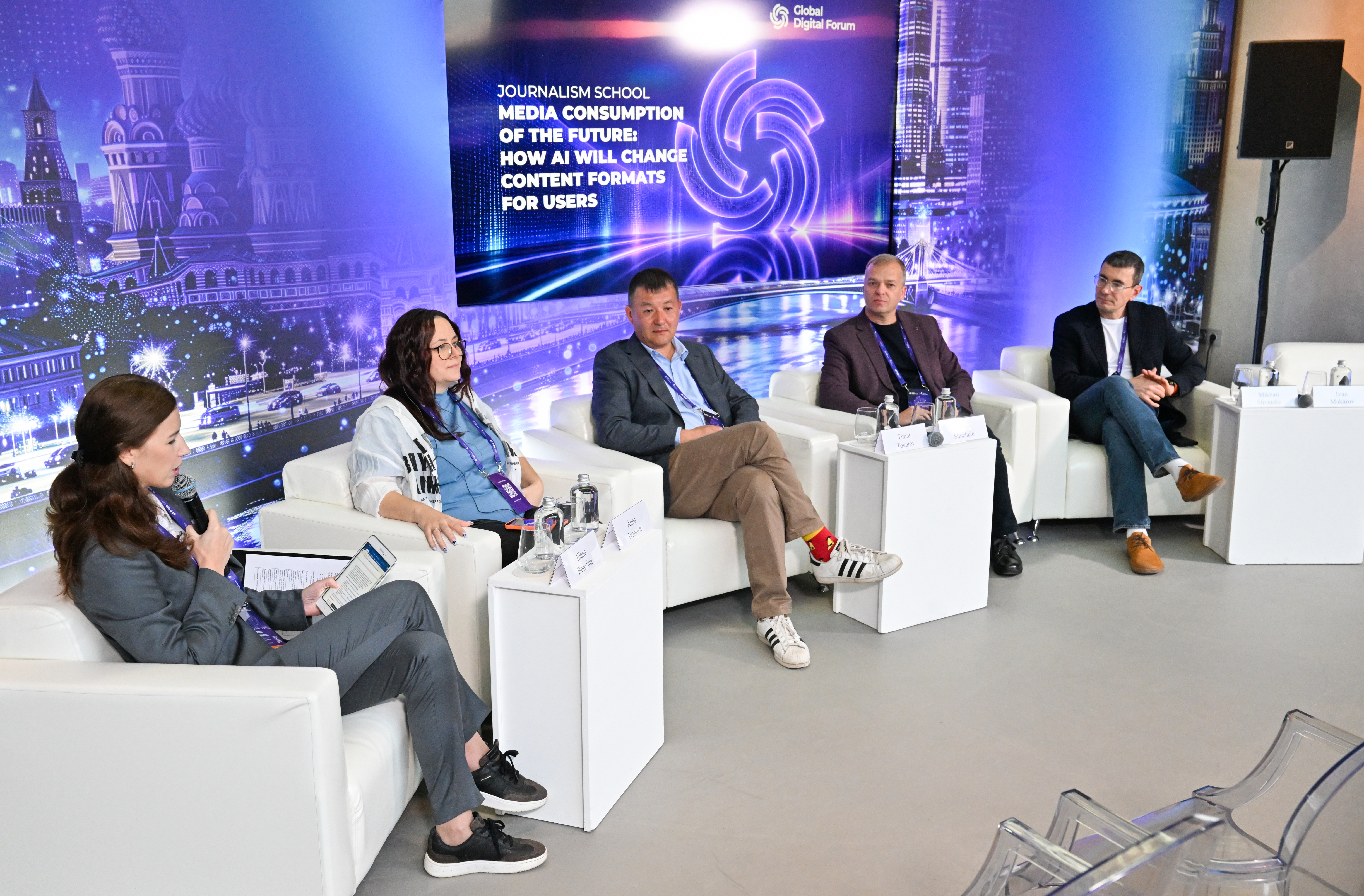
The boundaries between text, video, and audio are blurring; the algorithm is becoming a co‑author, and the cost of producing a unit of content is approaching zero. During a session at the journalism school, experts discussed how neural networks will change information formats for a mass audience.
“The information environment today is becoming increasingly fragmented. Users receive news not only on the website of a specific publication or in search results, but also through social media, platforms, recommendations, voice interfaces, and chatbots. Moreover, search is turning into an interface providing ready‑made answers from a catalog of links. And for us, as an editorial team, this primarily means having to re‑answer the question of why the audience should go to the original source,” First Deputy Editor-in-Chief of Rossiyskaya Gazeta, member of the Public Chamber at Roskomnadzor Elena Berezina said.
Referring to data from the Reuters Institute for the Study of Journalism, the expert noted that in 2025, some 24% of the audience used generative AI on a weekly basis to search for information, while about 6% used it to get news. According to her, one of the main challenges for the media is to reconcile the development of new technologies with maintaining the audience’s trust.
Executive Director of the Rambler portal Anna Ivanova spoke in detail about how audience expectations are changing amid the spread of artificial intelligence.
She noted that users are getting used to receiving information quickly and in a conversational format. This is influenced not only by the development of AI but also by changes in other digital services which offer convenient solutions for various tasks.
“Around 78% of the Russian population already use an AI‑based app at least once or twice a week.” What does it mean? “This means that users themselves get used to receiving information quickly, in a conversational format,” she added. Furthermore, Anna Ivanova noted that the media should not necessarily completely restructure the media content to fit into a conversational format. Technologies should be implemented which will make it possible to turn existing publications into an interactive scenario.
In turn, Mikhail Slivinsky, an ambassador for Yandex Search Web Platforms, drew attention to the hyper‑personalization of the internet search.
“Dozens of percent of requests are unique requests that didn’t exist yesterday and most likely will not exist tomorrow,” he emphasized.
Another topic of discussion was the adaptation of media to the distribution of AI search and ready‑made answers. Ivan Sinichkin, deputy editor‑in‑chief of RG Media, spoke on this topic.
In his view, while editorial teams used to focus on headlines, clicks, and website visits, now their materials can be used by neural networks without the reader having direct contact with the original source. He also noted that editorial teams need to take into account the algorithms used by neural networks.
In turn, Director of Digital Marketing at Shkulev Holding Timur Tokurov said that the media still does not have a unified approach to assessing the visibility of content in generative AI responses. Although companies are developing their own monitoring tools, the concept of visibility is interpreted in different ways, and no generally accepted standards exist yet.