

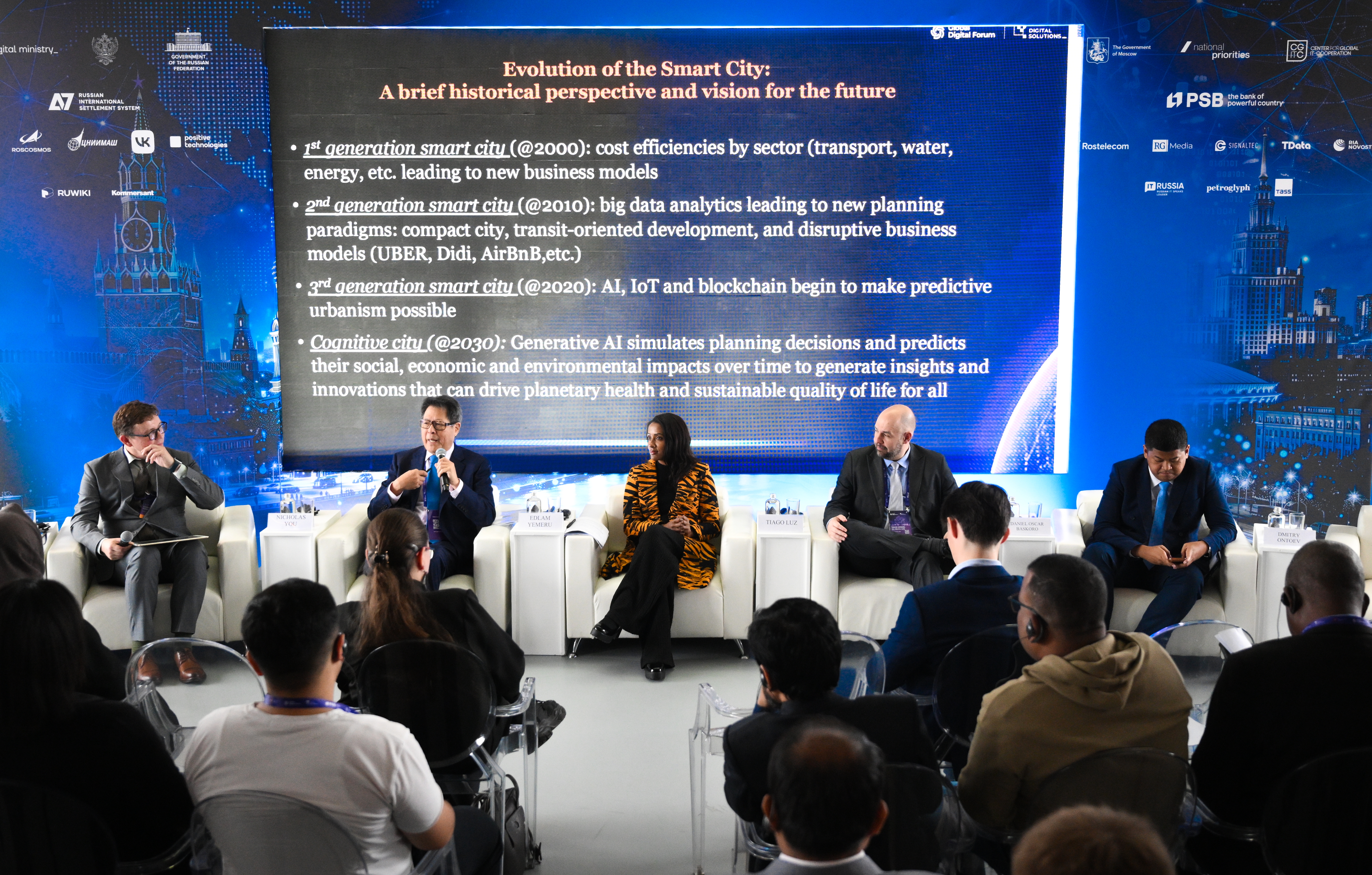
The key topics of the session “Smart City KPIs: A New Quality Standard” included the digitalization of major cities, the need to integrate urban systems, and the role of AI in city management.
Tiago Luz, Director of PRODAM-SP, a municipal IT company from Brazil, believes that digital services cannot operate effectively without data integration.
“Only data that is genuinely relevant should be collected and then integrated,” he said. “In a city like Moscow, for example, these systems are up and running and interact with one another. It is somewhat more difficult in our case, because the heads of certain agencies consider data to be their property and are reluctant to share it.”
Tiago Luz also stressed that AI should not make decisions on city management independently.
“Can artificial intelligence make decisions for us?” he asked. “No. Only we, as human beings, can do that. AI can offer suggestions, but we are ultimately responsible for the decisions we make and their consequences.”
He argued that humanity would have to learn to live side by side with AI as it continued to develop. However, neither technology nor cloud services could replace human responsibility for decision-making.
Nicholas You, an adviser to the mayor of Guangzhou, China, and Executive Director of the Institute for Urban Innovation, praised the level of digitalization in the Russian capital.
“Today, [Moscow – Ed.] ranks among the world’s top three largest digital twins,” he said.
Nicholas You also cited the Chinese port city of Qingdao, where a platform that rewards environmentally friendly transport with tokens has helped reduce carbon dioxide emissions by 320,000 tonnes.
“The platform brings together 9.4 million users <…> and has helped remove 320,000 tonnes of carbon dioxide from the atmosphere. [The app – Ed.] issues tokens as rewards, so every time you use an environmentally friendly mode of transport, you earn a token,” he said.