

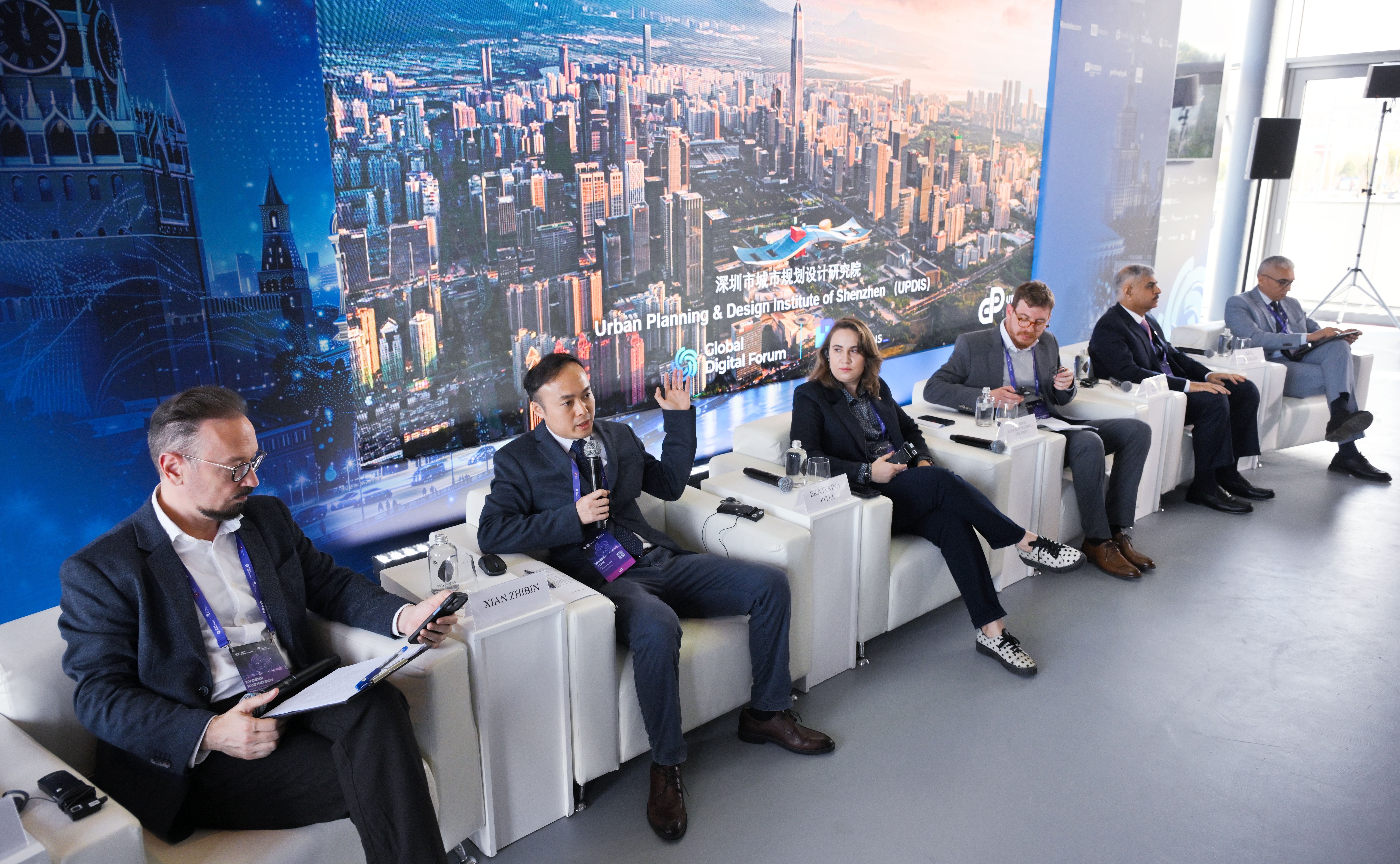
How are digital replicas of cities becoming the technological foundation for a new level of governance, helping make management decisions and optimize urban resources? These were the key topics explored during the panel discussion, The City in 3D: How Digital Twins Are Transforming Urban Life.
As technology advances, an increasing number of metropolises are deploying digital twins to address complex challenges – from long-term planning and traffic modeling to environmental monitoring. According to the Moscow Department of Information Technology (DIT), there are now more than 1,200 digital twins worldwide, each tailored to the unique characteristics of its respective region.
“The implementation of digital twins has helped reduce the time required for administrative decision-making from roughly ten months to seven, and some urban planning decisions can now be made within a matter of hours,” said Ekaterina Pitel, Head of the Digital Twin Development and Data Analytics office at the Moscow DIT.
The expert also highlighted that Moscow’s digital twin even allows users to peer into the future: the “curtain” feature allows users to visualize what an area will look like before and after proposed modifications, providing a clear picture of how a planned building will fit into the city’s architectural landscape, whether it will obstruct playgrounds, and how it will appear at different times of the day and in various weather conditions.
Simon Xian, Head of Urban Planning, International Cooperation Coordinator, Urban Planning & Design Institute of Shenzhen (China), stated that his city’s digital twin has been operational since 2023.
“It can be used to forecast and simulate severe weather events, such as floods, strong winds, and heavy rain,” he added.
Guilherme Henrique Fatorelli Del Arco, Urban Development Director, São Paulo Urbanismo, São Paulo City Hall (Brazil), noted that digital models can be used to monitor noise levels from stadiums, thereby improving the quality of life for residents.
“However, AI should serve as an assistant, not a decision-maker. Accountability must ultimately rest with humans,” he stressed.
Ahmed Abdulaziz Al Khayyat, Director of the CEO Office, Urban Planning and Development Authority (Bahrain), praised the digital twin projects in Russia, China, and Brazil, and joined the other experts in agreeing that digital twins should assist people rather than replace them.
The panelists also concurred that over the coming years, digital twins will continue to evolve through integration with AI agents, making it possible to anticipate future scenarios even before decisions are made.