

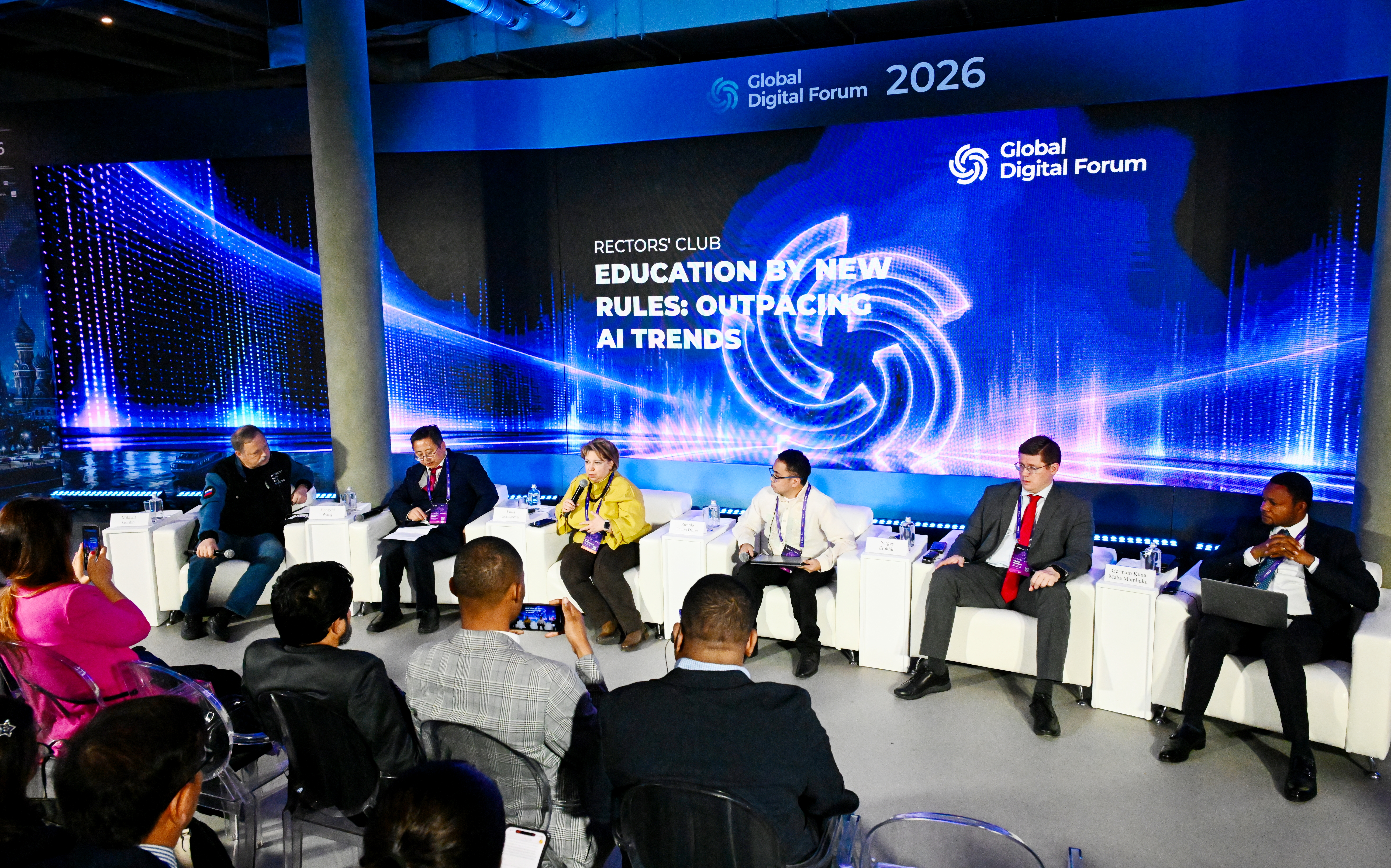
Artificial intelligence is changing the mix of sought-after skills and prompting adjustment to educational approaches. Skills that employers once valued high are being delegated to AI, while the focus is shifting to system thinking, interdisciplinary knowledge, and the ability to work with AI.
How can universities train specialists for a labor market whose rules are still in the making? And how can an education system be built to keep ahead of technological change? These questions were discussed at a session titled “Rectors’ Club: Education by New Rules. Staying Ahead of AI Trends.”
Rector of Skolkovo Institute of Science and Technology (Skoltech) Yulia Gorbunova believes that AI is a tool that students should learn to use from an early age, while continuing to study main traditional subjects.
“The fundamentals must remain unchanged. The advent of artificial intelligence has not altered the basic laws of mathematics, physics, or chemistry, and students must continue to learn these subjects,” Gorbunova said.
She sees the solution for higher education institutions in developing specialized interdisciplinary programs for senior-year students.
“In the senior student years, education should certainly become more flexible and more focused,” she emphasized.
Gorbunova described Skoltech’s educational model, in which the main level of study begins with a master’s degree. The university develops curricula around specific scientific challenges of the day and involves technology partners in addressing them.
Rector of the Moscow Technical University of Communications and Informatics Sergei Yerokhin believes that AI is just another stage in the development of technology and culture.
“Today, a well-crafted prompt can solve a problem that would’ve taken a month of work before. This means that new, more advanced challenges will emerge, and the students we are training today must be able to tackle them,” the rector said.
Yerokhin also noted that educational curricula in Russia are currently revised once a year, and he does not believe in making changes during the academic year.
Rector of the University of Congo Germain Kuna Mabamambuku said that despite the use of AI tools, teachers remain at the center of the education system.
“For me, humans remain in control of artificial intelligence. We must not forget that humans created it, and even decades from now, we will still be in control of it,” he noted.
Director of the Polytechnic University of the Philippines Ricardo Laurio Dizon believes that AI’s impact on the labor market is making the development of less affluent countries and their universities a more challenging task.
“Universities face difficulties, particularly budget constraints. Updating curricula and equipment has become a regular necessity,” the speaker said.
Dizon said that cooperation, particularly at the international level, could prove decisive in the race to modernize.
Vice President of Shanghai University of Electric Power Hongzhi Wang highlighted a growing trend: businesses are now determining which specialists are in demand.
“Companies specify the particular fields of specialization they need and the skills students should acquire, while the government must facilitate this process and develop support measures,” the Chinese representative said.